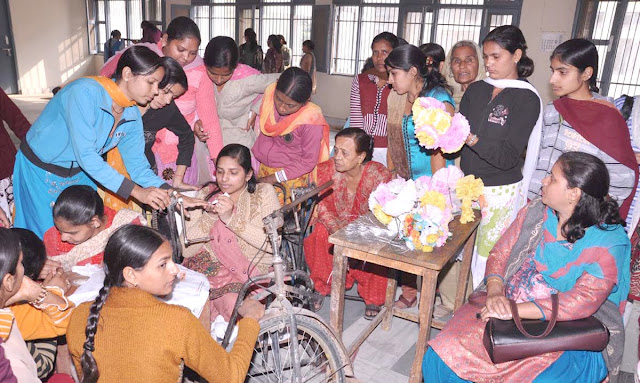
Women are second to none in any field. If the will to do something is there and the resolve to prove it, anyone can accomplish even the hardest of tasks with ease. Gitanjali, a young woman from Safidon in Haryana, lives by exactly that spirit. Despite being physically disabled, she carries out her work in a manner that perhaps even a fully able-bodied person could not match. Though born into a well-off family, Gitanjali wanted to achieve something entirely on her own.
Unable to walk properly, Gitanjali refuses to be a burden on anyone and manages every task herself. Over the years she has taken up work of every kind — applying mehendi (henna), stitching clothes, tutoring children, and embroidery — and become so skilled at each that perhaps no one else in the area matches her talent. She has entered numerous competitions in these crafts and won first place many times. Local social organisations have honoured her repeatedly for her outstanding work, and her family takes great pride in her achievements. Her mehendi designs, in particular, draw people from far and wide who come specifically to have her apply mehendi for them.
Despite her disability, Gitanjali completed an MA in English and a B.Ed, and went on to earn a diploma in Arts and Crafts as well. She now works as a manager at a private school in Safidon. Most notably, none of Gitanjali's skills were taught to her formally — she acquired every one of them through her own hard work, proving that a body that isn't fully able need not stand in the way of what a determined person can achieve. In earlier times, women were often thought lesser than men; today, women have moved so far ahead that they leave men behind, and a young woman like Gitanjali has become a genuine source of inspiration.
Her home, lit up by her own hands
Where society often regards a son as the light of the household, Gitanjali has proven herself the light of
her own home. Step inside and her artwork greets you on every wall — paintings and craftwork that give the
house a distinct identity of its own. Visitors cannot help but admire the decorated walls: oil painting,
fabric painting, calligraphy, embossed painting, spray painting and sponge painting all feature throughout
the house. No one who visits leaves without remarking that Gitanjali has truly lit up her own home.
In her own words
Gitanjali says a person should never dwell on the thought that something is missing from their body — that
kind of thinking only holds people back from their work. Whatever body one has been given, she believes,
should be put to its fullest use rather than resented. She credits her family with a big part of her
success, saying she never wanted to be a burden to them; and she hopes that if the government recognised
her ability and offered her a government job, she would never need anyone's support, even later in life.
A mother's pride
Gitanjali's mother, Urmila, is deeply happy to have such a talented daughter. Even as she recalls her
daughter's condition, her eyes well up — yet it was Urmila who encouraged Gitanjali at every step and gave
her the confidence to stand on her own feet. She says watching Gitanjali struggle as a child was painful,
but Gitanjali overcame it all through talent and hard work, and the family now considers itself fortunate
to have a daughter like her. Urmila's one regret: despite all its promises to uplift people with
disabilities, the government has never taken any real step to help her daughter.